First episode of AI Fluency, a series that walks through the AI Fluency Framework one competency at a time. This one draws the whole map; each of the next four takes one of its branches.
Almost everyone who uses generative AI has lived the same small moment. You ask for something you need, a summary of a long report, a first draft of a hard email, an explanation of a clause or of a line of code, and a few seconds later the answer is on the screen, fluent, well organised and confident. Then the question that the speed had postponed arrives all at once: can I use this? Is it right, is it what I actually needed, should I have asked for it at all, and if I send it on, whose work is it?
Most of us learned to use these tools by trial and error, so we answer that question by instinct, a little differently every time. Yet the people who use AI well, whether they are developers, lawyers, accountants, managers or students, tend to do the same few things, even if few of them would put those things into words. That is the gap the AI Fluency Framework fills. Developed by Rick Dakan, Joseph Feller and Anthropic, it defines fluency as the ability to work with AI in ways that are effective, efficient, ethical and safe, and it organises that ability into four interconnected competencies, all of which begin with the letter D. This first episode is the map of the whole territory, drawn so that you can see every part at once before we walk through it piece by piece.
The map
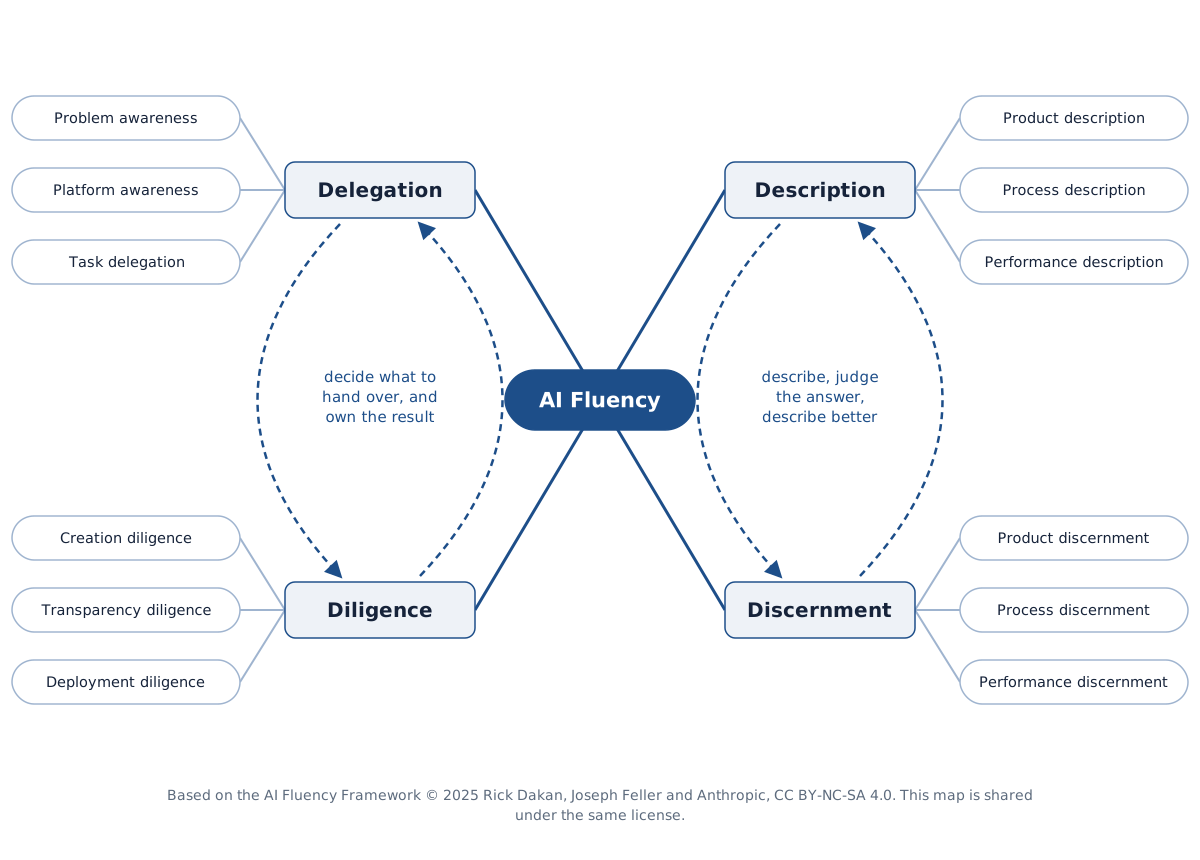
The map reads from the centre outwards. Each of the four Ds is a branch, and each branch carries three more specific skills, twelve in all. The framework describes the four competencies themselves as interconnected collections of skills, knowledge, insights and values, rather than tricks to memorise. The dashed lines matter as much as the branches, because they show that the four competencies are not a checklist to tick in order but two pairs that keep feeding each other. I will come back to them once each branch has been introduced.
Delegation: deciding what to hand over
Delegation is the work that happens before you type anything: setting your goal and deciding whether, when and how to bring AI into it at all. It starts with problem awareness, understanding what you are actually trying to achieve and what kind of work that involves, because a vague goal produces a vague request. It continues with platform awareness, knowing what the particular AI system in front of you does well and where it is limited, which is not the same for every tool. And it ends in task delegation, the choice of which parts of the work to give to AI and which to keep, so that each side does what it is better at.
Description: saying what you need
Description is how you communicate with the AI so that it produces something useful, and the framework asks you to describe three different things. Product description defines what you want to receive: the output, its format, its audience and its style. Process description defines how the AI should approach the task, for example the steps it should follow. Performance description defines how it should behave while working with you, more concise or more detailed, more challenging or more supportive. In my experience most people only ever describe the first of the three, and that alone can make the same tool feel brilliant to one person and useless to the next.
Discernment: judging what comes back
Discernment is the ability to assess, accurately, how useful the AI’s output and behaviour really are, and it mirrors Description almost word for word. Product discernment looks at what was produced: is it accurate, appropriate, coherent and relevant? Process discernment looks at how the AI got there, watching for logical errors, lapses of attention or reasoning steps that do not hold. Performance discernment looks at how the AI behaved during the conversation and whether its way of communicating actually worked for you. This is the competency that answers the question from the opening moment, and it is the one that fluent, confident prose makes easiest to skip.
Diligence: owning the result
Diligence is taking responsibility for what we do with AI and how we do it. It begins with creation diligence, being thoughtful about which AI systems you use and how you interact with them. It carries on into transparency diligence, being honest about the role AI played in your work with everyone who needs to know. And it ends in deployment diligence, taking responsibility for checking and vouching for anything you use or share, because once it leaves your hands it carries your name and not the tool’s.
Two loops, not a straight line
Seen one at a time, the four Ds could pass for a sequence, but Anthropic’s own course on the framework describes them as two loops. The first joins Delegation and Diligence: it covers the strategic and ethical decisions about using AI, what to hand over and how to stand behind the result, and in my reading it closes because what you learn by owning the outcome changes what you will delegate the next time. The second joins Description and Discernment: it is the moment-to-moment craft of a conversation with AI, in which you describe what you need, judge what comes back and use that judgement to describe it better. The course also teaches how the two loops interact in real collaboration, a thread the later episodes will keep returning to.
Three ways of working with AI
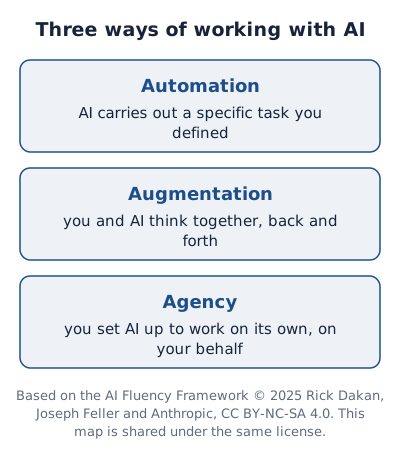
The framework adds one more idea that helps make sense of the map: there are three ways people and AI work together. In automation, the AI carries out a specific task based on your specific instructions, so you define what needs doing and it does it. In augmentation, you and the AI work as thinking partners, in an iterative back-and-forth to which both contribute. In agency, you configure the AI to work on its own on your behalf, sometimes with other people or other AI systems, and instead of dictating each action you establish what it knows and how it should behave. In my reading, the mode you are in changes what each competency asks of you: in agency, for instance, your description has to hold for many future tasks rather than a single answer.
Back to the answer on the screen
Return to that confident answer and the question it raised. With the map in hand, “can I use this?” stops being one question answered by instinct and becomes four you can actually work through. Did I hand over the right part of the work, to a tool that is good at it? Did I describe not only what I wanted but how it should be done and how the AI should work with me? Have I judged the result, the reasoning behind it and the way it was delivered? And am I ready to be open about the AI’s part and to vouch for what I am about to share? None of these questions needs technical knowledge, which is why the framework works as well for a lawyer as for a developer, and why I wanted a map that anyone can read.
That is also the route this series will take. Each of the next four episodes takes one branch of the map and walks it in depth, in the order I find most natural to follow: Delegation first, then Description, Discernment and finally Diligence. By the end, the twelve names on the branches should feel less like vocabulary and more like habits, and the moment after the answer appears should feel like the start of your part of the work rather than the end of the AI’s.
Sources: Anthropic’s AI Fluency Framework and Key Terminology Cheat Sheet, © 2025 Rick Dakan, Joseph Feller and Anthropic, CC BY-NC-SA 4.0, and the courses Teaching AI Fluency and AI Fluency: Framework & Foundations. This article is an independent introduction, not an Anthropic publication.