Second episode of AI Fluency, a series that walks through the AI Fluency Framework one competency at a time. Episode 1 drew the whole map; this one walks its first branch.
Picture a Thursday evening with a feature due on Monday. The online store needs a new coupon rule at checkout in time for Black Friday, and everything you need to know about it is scattered across the ticket, a couple of chat threads, a spreadsheet from finance and your notes from three meetings. The week has left you with very little energy, so you open an AI assistant and type something like “add the coupon rule to our checkout”. The answer arrives in seconds and it looks like code: a tidy function, a handful of tests, even comments. On a second look, though, it calls a payment function your system has never had, it is written for an older version of the library you use, and it lets the coupon stack with the discount for paying upfront, which is exactly what finance said in the second meeting must never happen. The tests pass only because they check what the code does rather than what the business asked for, and a good part of your weekend goes into pulling it apart.
The instinct at that point is to blame the prompt and to look for a better way of asking, which is a real skill and the subject of the next episode. Yet the trouble in that scene began a step earlier, before a single word was typed, at the moment you handed over the whole job, including the parts only you could do. The AI Fluency Framework, developed by Rick Dakan, Joseph Feller and Anthropic, calls that earlier step Delegation: setting goals and deciding whether, when and how to engage with AI, which in practice means deciding what work should be done by people, what work should be done by AI and how to distribute it between them. Of the four competencies on the map it is, in my reading, the one that usually comes first and the one that is easiest to skip, because skipping it feels like saving time.
The branch, up close
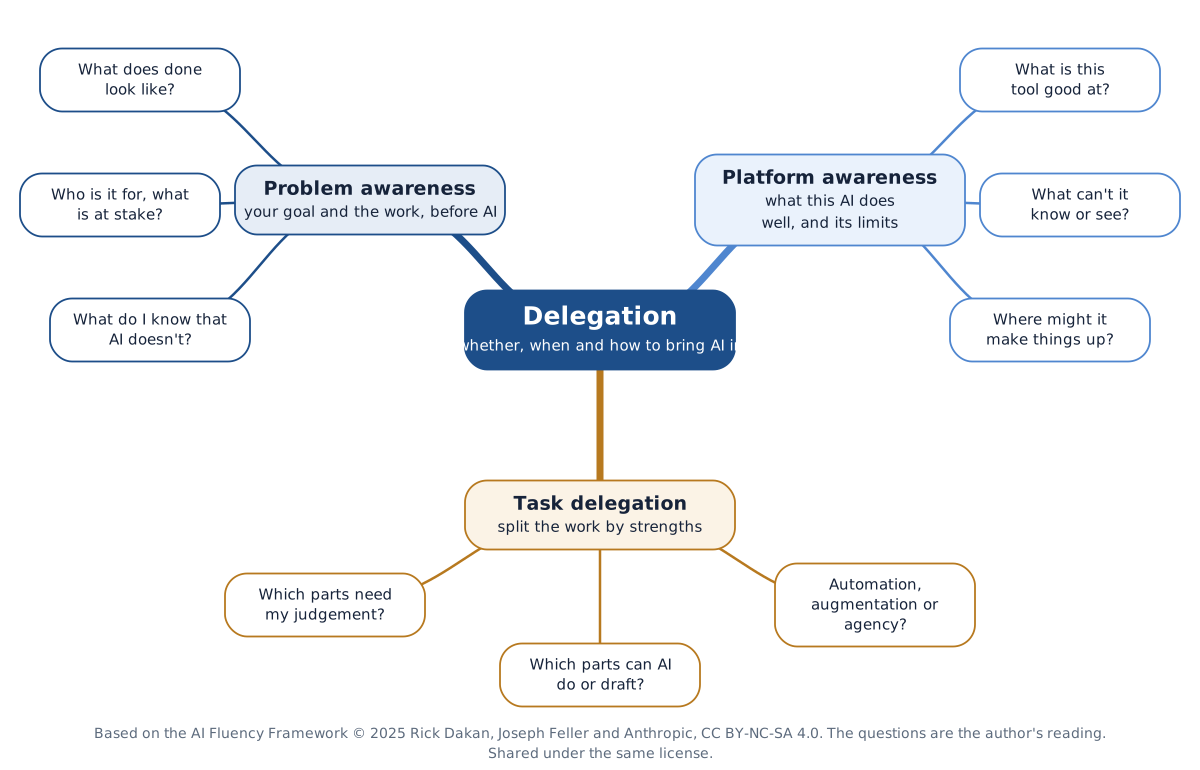
The framework splits Delegation into three skills, and the map adds, around each one, the questions I find myself asking when I practise it. The skills are the framework’s and the one-line summaries condense its definitions, while the questions are mine, offered as a way in rather than as part of the official text. Read from the upper left, round to the right and down, the branches go from the work to the tool and then to the split between the two, which is also the order in which the decisions tend to happen.
Problem awareness: knowing what you are actually asking for
The framework defines problem awareness as clearly understanding your goals and the nature of the work before involving AI. It sounds obvious until you notice how easily it slips under pressure, because the goal in the checkout scene was never “a coupon feature”; it was a Black Friday promotion that could not eat into the margin, which meant a coupon that does not stack with the upfront-payment discount, one use per customer, and a checkout that cannot get slower on the busiest day of the year. Once the goal is put that way, the nature of the work changes too, since a good part of it turns out to be pinning down rules and edge cases that only the team knows, and very little of it is typing code.
The questions on the map are a short way of getting there. What does done look like, so that you would recognise it if you saw it, the way a good acceptance criterion does? Who is it for, and what breaks if it goes wrong? And what do I know that the AI doesn’t, the history of the code, the decision taken in that meeting, the rule nobody wrote down, which no system will guess on its own? Anthropic’s own research suggests this step is far from universal. In the AI Fluency Index, a study published in February 2026 that classified fluency behaviours in 9,830 conversations on Claude.ai, the behaviour I read as closest to problem awareness, clarifying the goal before asking for help, appeared in about half of them, 51.1%, which means that in the other half the goal was never put into words before the request, much as it was not on that Thursday evening.
Platform awareness: knowing the colleague you are briefing
The second skill, platform awareness, is understanding the capabilities and limitations of different AI systems, and it asks for no deep technical knowledge. It is closer to what you would want to know about a capable new colleague on their first day on the team before giving them a task: what they are good at, what they cannot possibly know yet and where they tend to bluff. The framework’s own glossary gives the vocabulary for the limits. A model has a knowledge cutoff, a date after which it has no built-in knowledge of the world, which is why it may write code for an older version of a library than the one you use. It has a context window, a limit on how much information it can consider at once, which varies from one model to the next. And it can hallucinate, stating something plausible and confident that is simply wrong, such as a function that sounds as if it ought to exist and doesn’t.
Each of those limits translates directly into a delegation decision: the AI in the checkout scene could not see your repository unless you showed it the code involved, so it guessed at a payment function instead of using the real one; it knew nothing of the three meetings, so it had no way of knowing the coupon must not stack. Tools also differ from each other, since some can read your whole project, run the tests or look up the documentation while others only see what you paste into the chat, so the same task can be a good delegation to one system and a poor one to another. Platform awareness is simply the habit of asking, before you hand something over, whether this tool is the right one for this part of the work.
Task delegation: splitting the work by strengths
The third skill, task delegation, is where the first two meet: thoughtfully distributing work between people and AI so as to use the strengths of each. Anthropic’s lesson on the subject adds a line I find useful, that effective delegation requires both domain expertise and an understanding of what AI can do. In my reading, that is why a developer who has spent years on the payment system delegates that work better than one who joined last week, and why the same experienced developer still needs to know the tool before the split can be a good one.
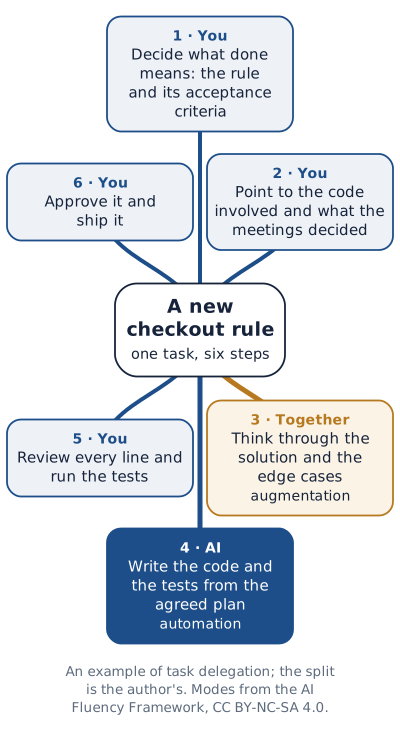
The figure replays the checkout rule with the task in the centre and the work split into six steps around it, clockwise from the top, which is very close to the exercise Anthropic’s course gives its learners: take a project with several steps, break it into tasks and plan which ones you will do yourself and which ones you will do with AI. In my split, deciding what done means, the rule and its acceptance criteria, stays with you, because it depends on what was agreed with the business, and so does pointing to the code involved and to what the meetings decided, because that lives in your repository and in your notes and not in the model. Thinking through the solution and the edge cases is done together, as a conversation. Writing the code and the tests from the agreed plan goes to the AI, which is fast and tireless at exactly that. Reviewing every line and running the tests comes back to you, and so, finally, does approving the change and shipping it, since it goes to production with your name on it. Nothing in that list is sophisticated, and that is the point: the same tool, given the fourth step instead of the whole job, produces something you can actually use.
Choosing how, and choosing not to
The labels on the figure point to the last decision on the branch. The framework describes three ways people and AI work together: automation, where the AI carries out a specific task on your specific instructions; augmentation, where you think together in a back-and-forth to which both contribute; and agency, where you set the AI up to work on its own on your behalf. In my reading, choosing among them is part of the “how” in “whether, when and how”, so it belongs squarely to Delegation, and the same piece of work can call for a different mode at each step, as it does in the checkout rule. The AI Fluency Index found that the most common expression of fluency it observed was augmentative, treating the AI as a thought partner rather than handing work over entirely. It also found that only about one conversation in ten, 10.1%, included the user consulting the AI on the approach before asking it to execute, which in my reading is perhaps the cheapest delegation question there is, much like asking a colleague for the plan before you ask for the code.
The “whether” in that definition deserves its own moment, because Delegation includes deciding to keep work. Some parts of a task carry judgement that is yours to exercise, such as which business rule wins when two of them collide or which design the team will have to live with for years; some carry responsibility that cannot be passed on, such as what goes to production; and some, for someone starting out above all, exist precisely so that you learn the system by doing them, in which case handing them over defeats the purpose. A good delegation leaves those with you on purpose, not by accident, and it is often the parts you keep that make the parts you hand over worth having.
The loop that brings you back
Episode 1 showed Delegation joined to Diligence in one of the framework’s two loops, which covers the strategic and ethical decisions about using AI. In my reading, the loop closes because owning the result teaches you what to delegate next time: the weekend spent hunting for a function that never existed is exactly what makes you show the AI the real code, and keep the business rules with you, on the next feature. Delegation is therefore not a decision made once and filed away but one you revise each time a result comes back, and the fifth episode, on Diligence, will walk the other half of that loop.
Back to Thursday evening
Return to the checkout and replay the evening with the branch in mind. Before opening the assistant, you spend a few minutes writing down what the rule is really for and how you will know it works; you remember that the tool cannot see your repository or your meetings, so you decide to show it the code involved and to bring the rules yourself; you split the work, think the solution and the edge cases through together, leave the first version of the code and the tests to the AI and keep the review for yourself. The prompt you finally type is not especially clever, yet it lands in a much better place, because the decision behind it, made before you typed and called Delegation by the framework, was a good one, and that decision works the same way for a database migration, a bug fix, a code review or a technical spec, and just as well outside code.
What it does not tell you is how to say what you need once you have decided to ask, and that is the subject of the next episode, on Description: how to describe the product you want, the process the AI should follow and the way it should work with you.
Sources: Anthropic’s AI Fluency Framework and Key Terminology Cheat Sheet, © 2025 Rick Dakan, Joseph Feller and Anthropic, CC BY-NC-SA 4.0; the course AI Fluency: Framework & Foundations; and The AI Fluency Index (Swanson, Bent, Ludwig, Dakan and Feller, February 2026). This article is an independent explainer, not an Anthropic publication.