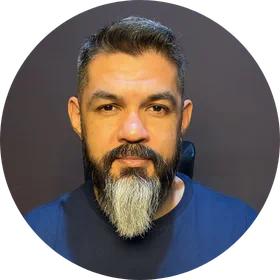
Ed Fernando Barros
Software & Solutions Architect
Twenty-three years building and running systems where failure is expensive — across stacks, teams and business domains that had little in common except the need to work.
- Brasnorte, MT — Brazil
- barrosef@gmail.com
- GitHub
- Financial services
- Crypto-asset trading
- Sports
- Energy
- Public security
- Tax & revenue
- Justice
I started in 2003 as a junior Java developer — Java 1.4, Struts and SOAP web services — and today I work in Java 21, Spring Boot, microservices and the cloud. Along the way I went through every generation of the platform: Java EE on JBoss and Tomcat, Spring and Hibernate, containers, Kubernetes, AWS and GCP — and, more recently, Go, Python, React and AI-agent-assisted engineering. I’m not attached to a stack; I use the one that solves the problem.
Roles
Over those years I have held nearly every role a technology team has:
- Developer, from junior to senior, with code in production to this day.
- Software architect, laying the foundation of entire ecosystems — data, integration, identity (OAuth2/OIDC, Keycloak, SSO), messaging.
- DevOps, building CI/CD pipelines, infrastructure as code (Terraform) and cloud environments designed for the load they will actually carry.
- Agile practitioner, running the product board, the delivery cadence and developer onboarding.
- Manager, building and leading Java teams from hiring through to structured handover.
- Advisor to strategic IT committees — governance, planning, public procurement and alignment with executive leadership.
Sectors
And in business segments that have little in common except the need to work:
- Financial services and fintech — integrations with crypto-asset exchanges, blockchain and financial systems, on AWS.
- Justice — ten years across two state Public Prosecutor’s Offices, and the integration of their systems with PJe, Brazil’s national electronic judicial process platform.
- Logistics — the driver’s app and the payroll pipeline of a last-mile operation.
- Healthcare — an AI-first delivery workflow, from the ticket to the pull request, across a multi-repository platform, at CSP Tech for Optum.
- Plus state tax collection, public security, energy, sports and geospatial environmental platforms for government agencies.
Own projects
Outside paid work, I maintain two projects that show how I think when nobody is footing the bill:
- Spartacus (volunteer, in production) — web back office and mobile app for a social project teaching jiu-jitsu, capoeira and Muay Thai to children in Brasnorte, Brazil. The business problem: track attendance, monthly food donations and communication with families without turning the secretary into a queue operator and without a hosting bill. The solution: one QR code per class instead of one per student, guardians acting on behalf of their children with dual authorship on every record, a FastAPI back end on Cloud Run, Firestore and Firebase Auth. Six repositories shipped to the families at zero operating cost, on GCP’s free tier.
- DOP (own product, open source, QA environment live) — an AI-first cockpit where a developer and an AI agent run a software demand end to end: environment, branch, development, pull request, delivery. It came out of a real client pain — the chain of hand-offs between person and agent loses state at every step — and grew into a platform: a Go core with a transactional event log, a Python BFF (REST, SSE and gRPC), a React cockpit and a CLI in daily use. Multi-tenant from the first migration, a second factor before the first organisation existed, 23 architecture decision records, all in Terraform and designed to carry no fixed monthly cost.
Both have the same character as my paid work: a clear business constraint, a technical decision that respects it, and a running system at the end.
How I work
What carries across all of it is the same thing. I adapt fast — to a new stack, a new team, a new domain. I absorb a company’s culture quickly and work well with development teams and product squads alike: I can talk code with the people who write it and priorities with the people who set them. I have built two engineering teams from scratch and handed both over running.
Above all, I solve problems. I turn business constraints into architecture a team can actually execute — and I stay until it runs.
And the rest
There is more to life than work. Barbecue, jiu-jitsu and a considered stance on liberty round things out — three interests that show up in the writing almost as often as anything technical. The career in detail, and each of them, gets its own corner here.